Links
Abstract
In contemporary times, numerous service robots are constructed with the basis of two-wheeled, self-balancing designs, due to their petite size and flexible movement, making them a suitable option for narrow spaces. These robots exhibit great potential in various domains like elderly care, disabled assistance, hazardous operations, education and entertainment, logistics handling, security, inspection, and more. Nevertheless, the obstacle-crossing ability, when faced with complex terrain such as rubble grounds, is insufficient and remains a challenge. This limits the overall applications of the robot. The objective of this thesis is to tackle the obstacle-crossing weakness by formulating a robust controller. The research content is as follows:
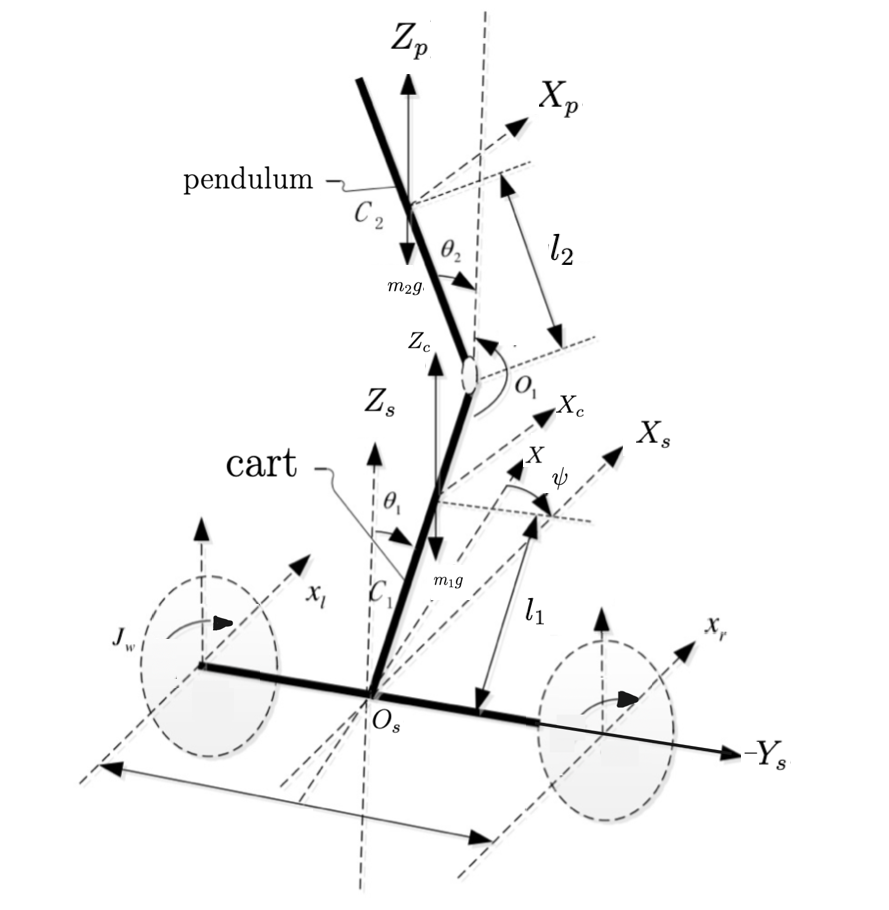
Firstly, the self-balancing robot structure, based on the double inverted pendulum, is proposed. This is a highly coupled nonlinear and underactuated system. The kinematic and dynamic models for the system are developed, and the system is linearized around the upright equilibrium position.
Secondly, theoretical studies are performed on three types of control algorithms; LQR, basic SMC, and hierarchical sliding mode control algorithms are tested through different experiments. The pros and cons of the three control algorithms are compared, providing a theoretical basis for the design of the subsequent controller.
Finally, the design for the controller and MATLAB simulation are completed. Experiments are conducted on linear and nonlinear plant, under varied disturbances. Through experimentation, it is proved that the hierarchical sliding mode controller exhibits better robustness than LQR controllers while also being efficient in suppressing external disturbances.
Figure 1: Structure modeling diagram